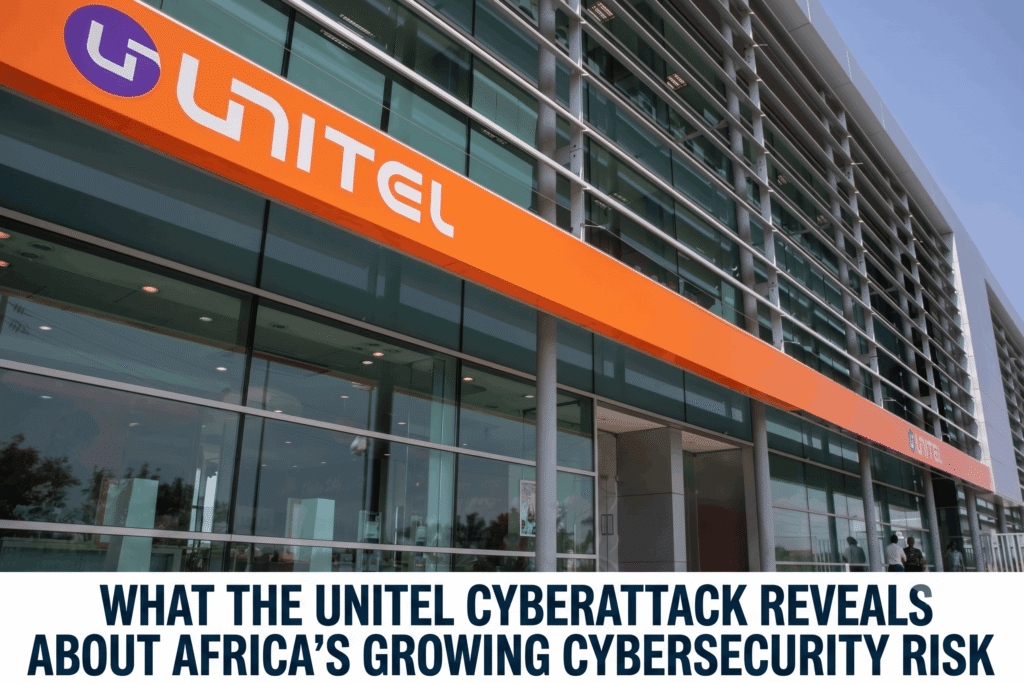
Hours before Angola’s largest telecom operator, Unitel, was set to debut on the country’s stock exchange, its network went dark. A cyberattack detected in the early hours of the morning knocked out voice, mobile data, and internet services nationwide, affecting more than 20 million customers, a day before what was supposed to be a landmark moment for Angola’s capital markets.
The timing made headlines, but the underlying story is bigger than one company’s bad week. It’s a case study in why telecom infrastructure across Africa has become an increasingly attractive target for cybercriminals, and what businesses operating in the region need to understand about that risk.
What Happened
Unitel, which serves over 21 million customers and holds roughly three-quarters of Angola’s telecom market, detected the attack on its technology infrastructure at approximately 2:20am local time. The company described it as a coordinated and continuous attack, and activated incident response and containment measures while working to restore full service.
The disruption came one day before Unitel’s shares were due to list on Angola’s stock exchange, BODIVA, as part of a broader partial privatization process. The Angolan state, through its asset management institute (IGAPE), had sold 7.5 million shares, roughly 15% of the company’s capital, in a public offering that closed on July 24, generating close to 300 million euros for the state.
Why Telecom Infrastructure Is a High-Value Target
Telecom operators sit at a uniquely sensitive point in a country’s digital infrastructure. Beyond phone and internet service, mobile networks in much of Africa underpin mobile banking, ride-hailing apps, point-of-sale payment systems, and increasingly, government services. When a network like Unitel’s goes down, the disruption cascades well beyond making phone calls, it can freeze small business transactions, delay emergency communications, and interrupt daily commerce at scale.
This combination of high dependency and, in many markets, historically under-resourced cybersecurity investment, makes telecom operators in emerging markets an attractive target compared to similarly sized companies in regions with more mature security infrastructure. Angola’s own communications regulator, INACOM, has previously noted that the country ranks among the highest in Africa for recorded cyberattacks, reflecting a broader regional pattern rather than an isolated incident.
The Business Angle: Why This Matters Beyond Angola
For companies operating in or expanding into African markets, the Unitel incident is a useful reminder of a few practical realities:
Critical infrastructure attacks can have market-moving timing. Whether coincidental or not, an attack landing the day before a major IPO underscores how operational security incidents can directly intersect with financial events, affecting investor confidence and market perception in ways that go beyond the technical damage itself.
Incident response speed is now a public-facing metric. Unitel’s public communication about detection time and containment steps reflects a growing expectation, from regulators, investors, and customers alike, that companies disclose cybersecurity incidents transparently and quickly, rather than downplaying them.
Redundancy and business continuity planning matter more in concentrated markets. With Unitel holding roughly 76% of Angola’s telecom market, a single company’s outage has an outsized national impact, a dynamic that exists in many African markets where one or two operators dominate. Businesses relying heavily on a single telecom provider in these regions may want to factor this concentration risk into their own continuity planning.
What Companies Can Learn From This
Regardless of the exact vulnerability exploited in this case, which Unitel has not disclosed publicly, the incident highlights a few cybersecurity fundamentals that apply broadly to any organization operating critical digital infrastructure:
- Regularly test incident detection and response times, since the speed of containment often determines the difference between a contained breach and a full-scale outage
- Maintain clear, pre-drafted communication protocols for public disclosure, since ambiguity during an active incident tends to erode trust faster than the incident itself
- Assess third-party and infrastructure dependencies, since customers and partner businesses relying on a single provider inherit that provider’s risk exposure
- Treat cybersecurity investment as a business continuity issue, not just an IT budget line, particularly for companies serving as critical infrastructure in a given market
Final Thoughts
The Unitel cyberattack is a reminder that cybersecurity risk in fast-growing markets isn’t a future concern, it’s a present one, often intersecting with major business milestones in ways that are difficult to predict. As African telecom operators continue to expand and, in some cases, go public, the pressure to demonstrate mature security practices, not just service quality, is likely to keep increasing.
This article is for general informational purposes only and reflects publicly reported information available at the time of writing. It does not constitute cybersecurity, legal, or investment advice.
Sources: Reuters, CNBC Africa, Lusa, Instituto Angolano das Comunicações (INACOM)
-------------
INFORMAÇÃO IMPORTANTE!
**Não recrutamos ninguém, as vagas aqui anunciadas pertencem aos anunciantes**.
No Procure Aqui, você encontra muito mais do que dicas para o seu crescimento profissional. Descubra vagas de emprego e comece a sua nova jornada agora mesmo!
-------------
Tags:emprego em Angola 2026, vagas de emprego em Luanda, emprego offshore Angola,concurso público Angola 2026, vagas sem experiência Angola, Estágio Remunerado, Sector Petrolífero, admissão função pública Angola
Clique aqui para ver outras vagas | Clique aqui para ver artigos para a sua carreira vagas