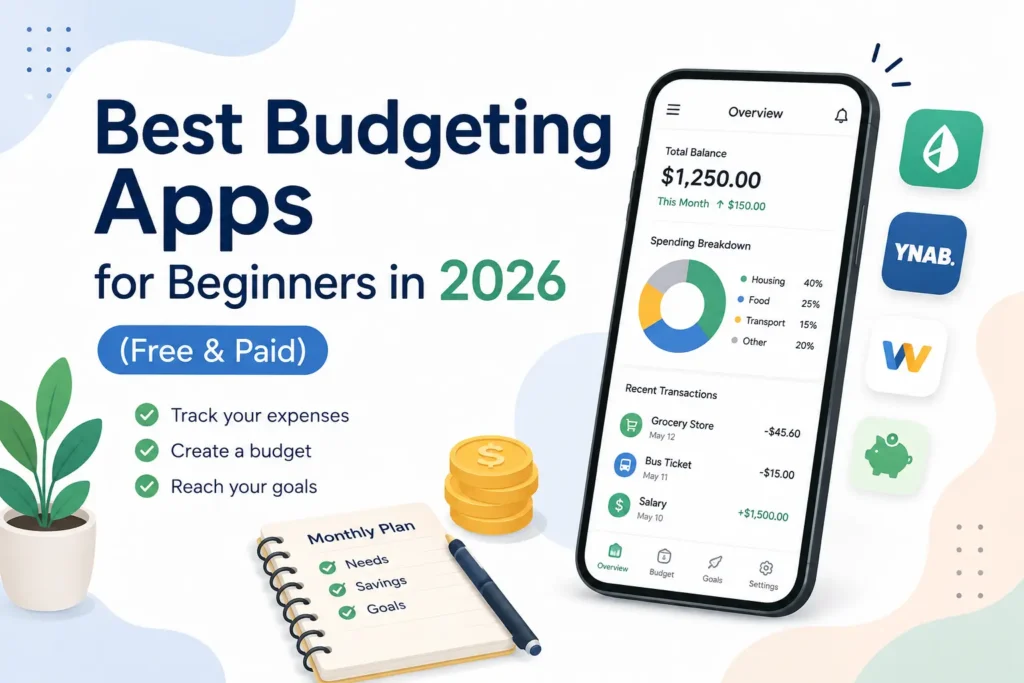
Managing money becomes much easier when you can see exactly where your income is going.
The problem is that traditional spreadsheets and notebooks can take time to maintain. A good budgeting app can automate much of the process, helping you track spending, create a monthly budget, monitor savings goals, and make better financial decisions.
But with so many personal finance apps available in 2026, choosing the right one can be confusing—especially if you are creating a budget for the first time.
In this guide, we compare some of the best budgeting apps for beginners in 2026, including free and paid options. We look at pricing, budgeting features, ease of use, and who each app is best suited for.
Quick answer: YNAB is one of the strongest choices for beginners who want a structured budgeting system. Empower Personal Dashboard is an excellent free option for tracking spending and overall finances, while Goodbudget is a good choice for people who prefer the traditional envelope budgeting method.
Best Budgeting Apps for Beginners in 2026
| Budgeting App | Best For | Free Option | Paid Option |
|---|---|---|---|
| YNAB | Structured budgeting | 34-day trial | $109/year or $14.99/month |
| Empower Personal Dashboard | Free financial tracking | Yes | Free |
| Goodbudget | Envelope budgeting | Yes | $10/month or $80/year |
| Rocket Money | Bills and subscriptions | Yes | Premium pricing varies |
| Monarch Money | Complete household finances | Trial | $99.99/year |
Prices and features can change. Always check the provider’s website before subscribing.
1. YNAB — Best Budgeting App for Beginners Who Want a Complete System
Best for: People who want to learn how to actively manage their money.
Price: $109 per year or $14.99 per month, plus applicable taxes.
Free option: 34-day free trial.
YNAB, short for You Need A Budget, is one of the best-known budgeting platforms for people who want more than a simple expense tracker.
Instead of simply showing where your money went, YNAB encourages you to give your available money a specific purpose. This makes it particularly useful for people who want to control spending, build savings, and plan ahead.
The current YNAB subscription costs $109 per year or $14.99 per month, and the company offers a 34-day free trial.
Why beginners may like YNAB
- Structured budgeting methodology
- Mobile and web access
- Bank account syncing in supported regions
- Manual transaction entry
- Savings and spending planning
- Educational resources and workshops
- Ability to share a subscription with up to six people
One important consideration is that YNAB is a paid budgeting service after the trial. Bank synchronization also depends on the country and supported financial institutions. YNAB says direct import currently supports selected banks in the United States, Canada, the United Kingdom, and the European Union.
Is YNAB worth paying for?
For someone who wants to seriously change their budgeting habits, it can be.
However, if you only want a free way to see your spending, a free budgeting tool may be enough.
Our verdict: ⭐⭐⭐⭐⭐
Best for: Active budgeting, savings goals, and people who want a structured financial system.
2. Empower Personal Dashboard — Best Free Budgeting App
Best for: Beginners who want free financial tracking and a broader view of their finances.
Price: Free.
If your priority is finding a free budgeting app, Empower Personal Dashboard deserves a place on your shortlist.
Empower says its Personal Dashboard and financial tools are completely free. The platform can connect financial accounts and provide an overview of spending, cash flow, investments, loans, and other financial information.
The platform is especially interesting for people who want to go beyond monthly budgeting.
You can use it to monitor:
- Spending
- Cash flow
- Net worth
- Savings
- Investments
- Retirement planning
- Debt
- Financial goals
Empower also provides free financial calculators for areas such as emergency funds, debt payoff, retirement, investments, and life planning.
The biggest advantage
The price.
You can start without paying a monthly subscription, making it attractive to students, young professionals, and anyone who is not ready to pay for budgeting software.
The limitation
Empower is better viewed as a broader personal finance dashboard than a dedicated zero-based budgeting system.
If you want detailed control over every dollar you earn, an app such as YNAB may be a better fit.
Our verdict: ⭐⭐⭐⭐½
Best for: Free spending tracking, net worth monitoring, and getting a complete picture of your finances.
3. Goodbudget — Best for Envelope Budgeting
Best for: Beginners who like simple, traditional budgeting.
Goodbudget takes the traditional envelope budgeting method and puts it into an app.
The basic idea is simple: instead of treating your entire bank balance as available money, you divide your budget into categories such as:
- Rent
- Groceries
- Transportation
- Entertainment
- Emergency savings
- Debt payments
Goodbudget offers a Free Forever plan with limited envelopes, one account, two devices, one year of history, and debt tracking.
Its Premium plan currently costs $10 per month or $80 per year and adds features including automatic bank synchronization for supported U.S. banks, unlimited envelopes and accounts, five devices, and seven years of history.
Why it is beginner-friendly
The concept is easy to understand.
If you put $500 into your grocery envelope, for example, you know that $500 is the amount available for groceries during the budgeting period.
That visual approach can make spending limits easier to understand than a traditional spreadsheet.
Who should choose Goodbudget?
Goodbudget is particularly useful if you:
- Prefer manual budgeting
- Like the envelope method
- Share finances with a partner or family
- Want a simple interface
- Do not need sophisticated investment tools
Our verdict: ⭐⭐⭐⭐
Best for: Envelope budgeting and simple household money management.
4. Rocket Money — Best for Tracking Subscriptions and Recurring Bills
Best for: People who want to control subscriptions, recurring bills, and everyday spending.
Rocket Money combines budgeting features with tools designed to help users understand recurring expenses.
Its free version includes features such as subscription tracking, budgeting, and bill reminders. Premium adds additional features, including custom budget categories, financial goal plans, credit score tracking, and real-time account syncing.
Unlike some traditional subscription apps, Rocket Money’s Premium pricing can vary because users are offered a sliding-scale price during signup. New Premium members also receive a seven-day free trial according to Rocket Money’s current help documentation.
Rocket Money also offers a bill negotiation service. If the service successfully saves you money, the company says its fee is generally 35% to 60% of the first year’s savings.
Why beginners may like it
Many people do not have a budgeting problem because they cannot calculate percentages.
They have a budgeting problem because small recurring expenses add up.
Streaming subscriptions, memberships, phone bills, internet services, and other recurring payments can quietly consume hundreds of dollars each year.
Rocket Money focuses heavily on helping users identify those expenses.
Our verdict: ⭐⭐⭐⭐
Best for: Subscription tracking, recurring bills, and identifying unnecessary expenses.
5. Monarch Money — Best for Complete Household Financial Planning
Monarch Money official website
Best for: Couples, families, and users who want a comprehensive financial dashboard.
Monarch Money is a premium personal finance platform designed to bring different parts of your financial life into one place.
Its current annual pricing is $99.99 per year, according to Monarch’s pricing information. The platform includes account connections, subscription tracking, investment performance tracking, custom reporting, budgeting, financial goals, and household collaboration.
One feature that makes Monarch particularly interesting for households is its support for collaborators. The company says users can invite unlimited collaborators.
What can you manage?
Depending on your setup, Monarch can help you track:
- Bank accounts
- Credit cards
- Investments
- Recurring subscriptions
- Budgets
- Financial goals
- Cash flow
- Net worth
Is Monarch good for beginners?
Yes—but it may be more than a complete beginner actually needs.
If you are starting with a simple goal such as “I need to stop overspending every month,” a simpler app may be easier.
But if you want one place to monitor your household’s broader financial picture, Monarch is worth considering.
Our verdict: ⭐⭐⭐⭐½
Best for: Household finances, financial planning, and advanced money tracking.
Free vs. Paid Budgeting Apps: Which Should You Choose?
The best budgeting app isn’t necessarily the one with the most features.
It is the one you will actually use.
Choose a free budgeting app if:
- You are just starting out
- You want to track expenses
- You do not want another monthly subscription
- Your financial situation is relatively simple
- You are learning basic budgeting habits
Empower is a strong starting point because its Personal Dashboard and financial tools are free.
Choose a paid budgeting app if:
- You want advanced budgeting features
- You need detailed financial planning
- You want more automation
- You manage finances with a partner
- You are serious about changing your spending habits
A $10–$15 monthly subscription may seem expensive when you are trying to save money. But if an app helps you identify unnecessary spending or consistently stay within your budget, the cost can potentially be small compared with the amount you save.
The important thing is to measure the value you receive, rather than assuming the most expensive app is automatically the best.
What Should a Beginner Look for in a Budgeting App?
Before paying for any personal finance app, consider these factors.
1. Ease of use
If the app is complicated, you may stop using it.
Look for a clean interface that makes it easy to see:
- Income
- Expenses
- Budget categories
- Savings
- Upcoming bills
2. Bank synchronization
Automatic account syncing can save time, but availability depends on the country and financial institution.
This is especially important if you live outside the United States.
Before subscribing, verify that your bank is supported.
3. Privacy and security
A budgeting app may handle highly sensitive financial information.
Check the provider’s privacy policy and understand what information is collected, how accounts are connected, and how your data is handled.
4. Savings goals
A good budget should not only tell you what you spent.
It should help you plan what you want to accomplish.
Useful goals include:
- Emergency fund
- Vacation
- Down payment
- Debt repayment
- New car
- Retirement
- Education
5. Pricing
Do not look only at the monthly price.
Compare the annual cost as well.
For example, YNAB currently costs $14.99 per month or $109 annually, while Goodbudget Premium costs $10 monthly or $80 annually.
How to Start Budgeting With an App
You do not need a complicated financial plan to begin.
Follow these five steps.
Step 1: Calculate your monthly income
Start with your reliable take-home income.
If your income changes every month, use a conservative estimate.
Step 2: List your fixed expenses
Examples include:
- Rent or mortgage
- Insurance
- Internet
- Phone
- Loan payments
- Utilities
Step 3: Track variable spending
This includes:
- Food
- Transportation
- Shopping
- Entertainment
- Restaurants
This is often where beginners discover the biggest opportunities to save.
Step 4: Create savings goals
Do not wait until the end of the month to see whether you have money left.
Set a specific amount aside for savings as part of your budget.
Step 5: Review your budget every week
You do not need to spend hours analyzing your finances.
A 10-minute weekly review can be enough to answer three questions:
Where did my money go?
Am I still within my budget?
What needs to change before the end of the month?
A Simple Budgeting Rule for Beginners
If you have no idea where to start, consider the 50/30/20 budgeting rule as a starting framework.
A simplified version is:
- 50% — Needs: housing, food, transportation, utilities
- 30% — Wants: entertainment, shopping, restaurants
- 20% — Savings and debt repayment
This is not a universal rule.
Someone living in an expensive city may need to spend more than 50% on necessities. Someone aggressively paying off debt may want to allocate more than 20% toward debt and savings.
The goal is not to follow a percentage perfectly.
The goal is to create a spending plan that matches your actual financial situation.
Best Budgeting Apps in 2026: Our Final Picks
After comparing the available features, pricing, and target users, here is our shortlist:
🏆 Best Overall for Active Budgeting: YNAB
Choose YNAB if you want a structured system and are serious about changing how you manage money.
💰 Best Free Option: Empower Personal Dashboard
Choose Empower if you want to track spending, net worth, investments, and other financial information without paying for the dashboard.
🧾 Best for Envelope Budgeting: Goodbudget
Choose Goodbudget if you prefer a simple envelope-based system.
📱 Best for Subscriptions: Rocket Money
Choose Rocket Money if recurring bills and subscriptions are your biggest financial headache.
👨👩👧 Best for Households: Monarch Money
Choose Monarch if you want a more comprehensive financial platform for managing household finances.
Frequently Asked Questions
What is the best budgeting app for beginners?
For beginners who want a structured budgeting system, YNAB is one of the strongest options. If you prefer a free solution, Empower Personal Dashboard is worth considering.
What is the best free budgeting app in 2026?
Empower Personal Dashboard is one of the strongest free options for tracking spending and viewing your broader financial picture. Goodbudget also provides a free plan with limitations.
Are paid budgeting apps worth it?
They can be, particularly if the app helps you consistently control spending, save money, or manage debt. However, paying for an app does not automatically make your budget better.
Is YNAB free?
YNAB is not permanently free. It currently offers a 34-day free trial, after which the service costs $109 per year or $14.99 per month, plus applicable taxes.
Can budgeting apps connect to my bank account?
Some can. However, bank synchronization depends on the app, financial institution, and country. Always check supported institutions before subscribing.
What is the easiest budgeting method for beginners?
A simple category-based budget is usually a good starting point. You can divide your money into necessities, discretionary spending, savings, and debt payments, then adjust the categories based on your actual spending.
Should I use a budgeting app or a spreadsheet?
A spreadsheet can be perfectly effective if you enjoy maintaining it manually. A budgeting app may be more convenient if you want automation, account synchronization, mobile access, and financial dashboards.
Final Thoughts
The best budgeting app is not necessarily the cheapest or the most advanced.
It is the one that makes it easier for you to understand your money and consistently make better decisions.
If you are completely new to budgeting, start simple. Try a free option such as Empower or Goodbudget’s free plan. If you want a more structured system, consider testing YNAB before paying for a subscription.
Most importantly, remember that a budgeting app is a tool—not a financial solution by itself.
The real benefit comes from using it consistently.
Track your spending. Set realistic goals. Review your budget regularly. Then adjust your spending based on what your numbers actually tell you.
That is how a simple budgeting app can become a useful part of a long-term personal finance strategy.
Important note
This article is for general educational purposes and does not constitute personalized financial, investment, tax, or legal advice. Pricing, features, bank integrations, and availability can change. Check each provider’s official website before opening an account or purchasing a subscription.
-------------
INFORMAÇÃO IMPORTANTE!
**Não recrutamos ninguém, as vagas aqui anunciadas pertencem aos anunciantes**.
No Procure Aqui, você encontra muito mais do que dicas para o seu crescimento profissional. Descubra vagas de emprego e comece a sua nova jornada agora mesmo!
-------------
Tags:emprego em Angola 2026, vagas de emprego em Luanda, emprego offshore Angola,concurso público Angola 2026, vagas sem experiência Angola, Estágio Remunerado, Sector Petrolífero, admissão função pública Angola
Clique aqui para ver outras vagas | Clique aqui para ver artigos para a sua carreira vagas