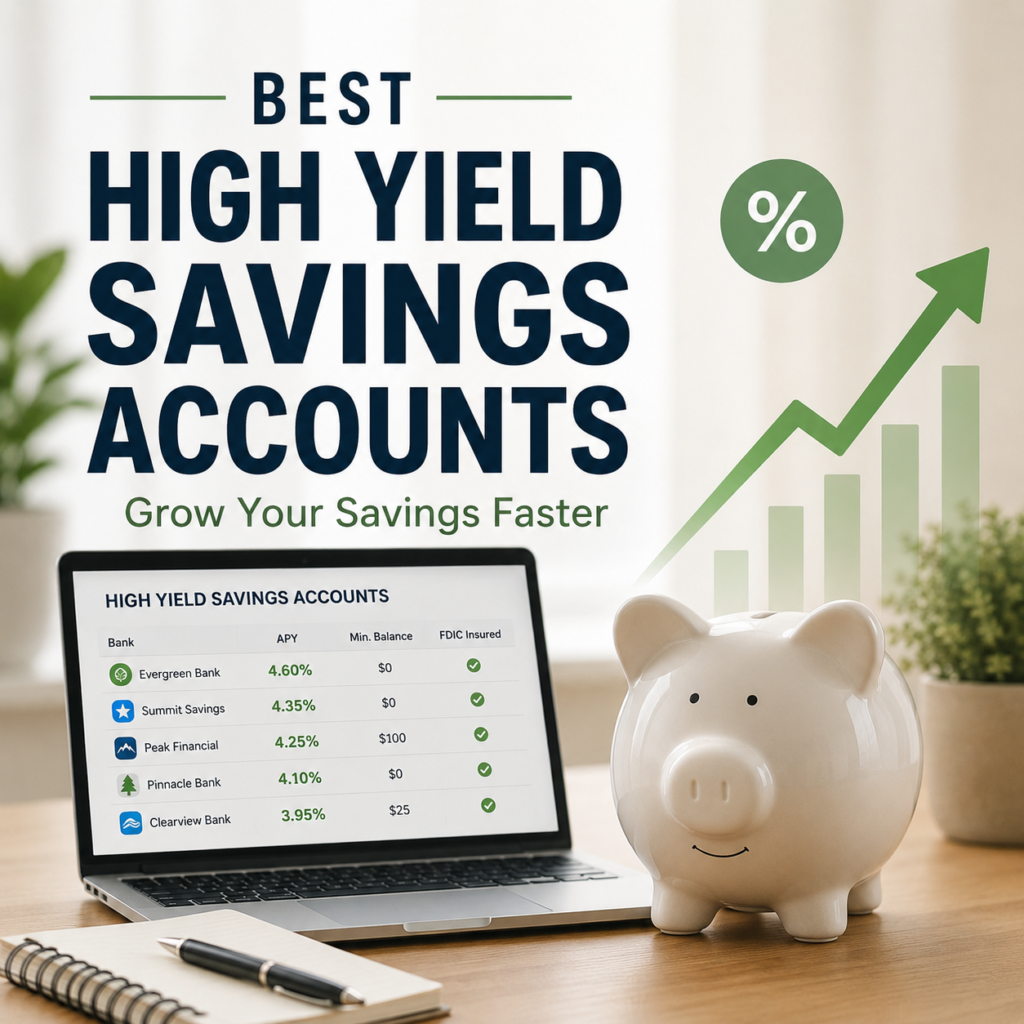
Best High-Yield Savings Accounts of 2026: Where to Earn the Most Interest on Your Cash
If your savings account is still paying you a fraction of a percent, you’re leaving real money on the table. The national average savings rate sits around 0.38% APY, according to the FDIC — but the best high-yield savings accounts (HYSAs) available right now pay 10 to 11 times that amount, with top offers ranging from roughly 3.75% to over 4.20% APY.
On a $25,000 emergency fund, that gap isn’t trivial. The difference between a typical brick-and-mortar savings account and a leading HYSA can work out to close to $1,000 a year in passive interest — money you earn simply by choosing a better place to park cash you already have.
This guide breaks down what a high-yield savings account actually is, how the top accounts compare in 2026, and how to pick the right one for your financial goals.
What Is a High-Yield Savings Account?
A high-yield savings account is a deposit account, typically offered by an online bank, that pays a significantly higher Annual Percentage Yield (APY) than the national average. Unlike checking accounts, HYSAs are designed for saving rather than everyday spending, though most allow easy transfers and some withdrawals per month.
Online banks can afford to pay higher rates because they don’t carry the overhead of physical branches — no rent, no tellers, no branch managers. Instead of spending on real estate, they pass those savings on to customers in the form of better interest rates.
Most HYSAs are:
- FDIC-insured (or NCUA-insured for credit unions) up to $250,000 per depositor, per institution, per ownership category
- Fee-free, with no monthly maintenance charges
- Variable-rate, meaning the APY can rise or fall based on Federal Reserve policy and market conditions
- Liquid, allowing you to move money in and out without penalties, unlike a CD
Top High-Yield Savings Accounts to Consider in 2026
Rates change frequently, so always confirm the current APY directly on a bank’s website before opening an account. That said, here’s a snapshot of what strong offers look like in the current market:
1. Accounts With Rates Around 4.00%–4.20% APY
A handful of online banks currently lead the pack with rates near or above 4.00% APY. These often come with reasonable minimum deposit requirements (commonly $0–$5,000) and no monthly fees. Some of the highest advertised rates require meeting specific conditions, such as maintaining a minimum daily balance or linking a checking account with recurring direct deposits.
2. Mid-Tier Accounts Around 3.50%–4.00% APY
Several well-known online banks and fintech platforms offer rates in this range with fewer restrictions — often no minimum balance and no direct deposit requirement. These are a solid choice if you want strong returns without jumping through hoops.
3. Hybrid Checking + Savings Platforms
A growing number of fintech-style banking apps bundle a savings account with a checking account, sometimes offering a boosted APY only when you set up qualifying direct deposits, with a lower base rate otherwise. These can be worth it if you’re consolidating your banking into one app, but read the fine print on what triggers the higher rate.
4. Promotional and Bonus Offers
Some banks sweeten the deal with cash bonuses for opening a new account and depositing a certain amount within a set window (commonly $200–$400 for deposits of $10,000–$25,000+), or with a temporary promotional APY for the first several months. These can meaningfully boost your first-year return, but the account’s standard long-term rate matters more once the promotion ends.
How to Compare High-Yield Savings Accounts
Don’t chase the top APY blindly. Here’s what actually matters when comparing accounts:
- APY (Annual Percentage Yield): The headline number, but check whether it’s a permanent rate or a limited-time promotional rate.
- Minimum balance requirements: Some top rates require a minimum opening deposit or ongoing balance to qualify.
- Monthly fees: The best HYSAs charge none — don’t settle for one that does.
- FDIC or NCUA insurance: Confirm the bank or credit union is federally insured before depositing a dollar.
- Withdrawal limits: Most accounts limit certain types of transfers per statement cycle; check if that fits how you use the account.
- Ease of access: Look at how quickly you can transfer funds to an external checking account when you need the money.
- Customer service and app quality: Since these are almost always online-only relationships, a solid mobile app and responsive support matter more than they would with a local branch.
High-Yield Savings vs. Other Options
| Account Type | Typical Rate (2026) | Liquidity | Risk |
|---|---|---|---|
| Traditional savings account | ~0.38% APY | High | Very low |
| High-yield savings account | ~3.5%–4.2% APY | High | Very low |
| Money market account | ~3%–4.5% APY | Moderate (check-writing, but tiered rates) | Very low |
| Certificate of Deposit (CD) | Varies, often fixed | Low (early withdrawal penalty) | Very low |
| Brokerage cash / T-bills | Varies with rates | Moderate | Low |
A CD may lock in a fixed rate for a set term, which can be an advantage if rates are expected to fall, but you sacrifice access to your money without a penalty. A money market account can offer similar or better yields with check-writing privileges, but often requires a higher minimum balance. For most people building or holding an emergency fund, a high-yield savings account offers the best balance of return, flexibility, and safety.
Is a High-Yield Savings Account Worth It?
For short- to medium-term savings — an emergency fund, a house down payment you’ll need within a couple of years, or cash you’re not ready to invest — a high-yield savings account is generally one of the safest and most efficient places to keep your money. Current top rates outpace recent inflation readings, meaning your money is realistically growing in purchasing power rather than just standing still.
That said, HYSAs aren’t designed for long-term wealth building. Historically, diversified investments have outperformed savings account interest over long time horizons, even accounting for market volatility. Think of a high-yield savings account as the foundation of your financial plan — the place for money you need to keep safe and accessible — not as a substitute for retirement or investment accounts.
Frequently Asked Questions
Are high-yield savings accounts safe? Yes, as long as the account is held at an FDIC-insured bank or NCUA-insured credit union and your balance stays within the $250,000 insurance limit per depositor, per institution. Your principal is not at risk the way it would be in the stock market.
Can I lose money in a high-yield savings account? No, assuming the institution is federally insured and you stay under the coverage limit. The only “risk” is opportunity cost if rates fall or if another account offers a better return.
How often do HYSA rates change? Rates are variable and can change at any time, often in response to Federal Reserve interest rate decisions. It’s worth checking your rate periodically and comparing it against current offers.
Can I have more than one high-yield savings account? Yes. There’s no legal limit on how many savings accounts you can hold across different banks. Many savers deliberately spread balances across two or three HYSAs to stay under FDIC limits, hedge against any single account’s rate dropping, or organize money by purpose.
Do I need a minimum deposit to open a high-yield savings account? It depends on the bank. Some accounts have no minimum at all, while others require an opening deposit ranging from $1 to $5,000 or more to access their top advertised rate.
Bottom Line
Letting cash sit in a low-rate savings account is one of the easiest financial mistakes to fix. Moving your emergency fund or short-term savings into a high-yield savings account takes minutes to set up and can add hundreds of dollars a year in essentially risk-free interest. Compare current APYs, fees, and requirements directly on each bank’s website before opening an account, since rates shift often and the best offer can change from month to month.
This article is for informational purposes only and does not constitute financial advice. Interest rates, terms, and promotional offers mentioned are illustrative of current market conditions and are subject to change. Always verify current rates and terms directly with the financial institution before opening an account.
-------------
INFORMAÇÃO IMPORTANTE!
**Não recrutamos ninguém, as vagas aqui anunciadas pertencem aos anunciantes**.
No Procure Aqui, você encontra muito mais do que dicas para o seu crescimento profissional. Descubra vagas de emprego e comece a sua nova jornada agora mesmo!
-------------
Tags:emprego em Angola 2026, vagas de emprego em Luanda, emprego offshore Angola,concurso público Angola 2026, vagas sem experiência Angola, Estágio Remunerado, Sector Petrolífero, admissão função pública Angola
Clique aqui para ver outras vagas | Clique aqui para ver artigos para a sua carreira vagas